
 by Paige Cerulli
4 Steps to Successfully Adopt Technology in Senior Care: How to Choose, Implement, and Scale with Confidence
Technology is becoming essential to nearly every aspect of senior living, but choosing the right solution is only the beginning. Long-term success depends on selecting technology that addresses real operational challenges, gaining support from staff, and implementing it with a clear plan.
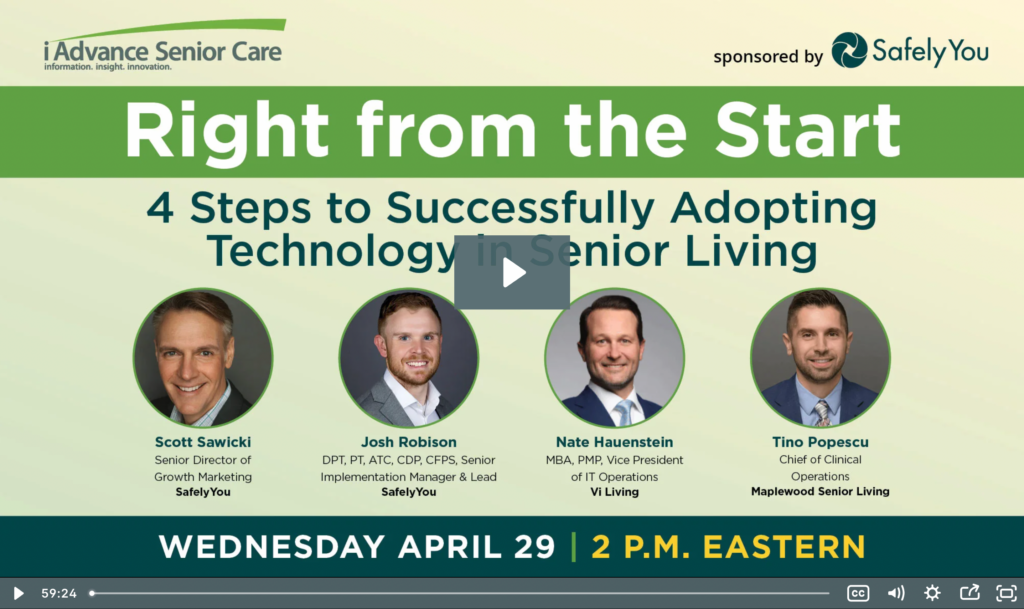
Industry leaders discussed these challenges in a recent iAdvance Senior Care webinar, Right from the Start: 4 Steps to Successfully Adopting Technology in Senior Living. The session brought together four experts to discuss how senior care communities can make smarter technology decisions and successfully implement new solutions.

(left to right): Scott Sawicki, senior director of growth marketing at SafelyYou; Josh Robison, DPT, PT, ATC, CDP, CFPS, senior implementation manager and lead at Safely You; Nate Hauenstein, MBA, PMP, vice president of IT operations at Vi Living; Tino Popescu, chief of clinical operations at Maplewood Senior Living
Panelists included:
- Scott Sawicki, senior director of growth marketing at SafelyYou
- Josh Robison, DPT, PT, ATC, CDP, CFPS, senior implementation manager and lead at Safely You
- Nate Hauenstein, MBA, PMP, vice president of IT operations at Vi Living
- Tino Popescu, chief of clinical operations at Maplewood Senior Living
Read on to learn a practical four-step framework for selecting, implementing, evaluating, and expanding technology that can deliver measurable results in your organization.
Laying the Foundation for Successful Technology Adoption
The discussion opened with a look at how senior living communities can approach technology adoption strategically rather than reactively. Sawicki introduced SafelyYou’s new guide to adopting technology and AI in senior living, which outlines a structured approach to implementation.
The discussion centered on four key phases of technology adoption:
- Selection
- Implementation
- Expansion
- Evaluation
Technology adoption has become increasingly important as senior living organizations face growing demands with limited staffing resources. Popescu emphasizes that technology can help communities deliver safer, higher-quality care without placing additional strain on employees. “Technology is really how we can close that gap without burning out our teams,” he says.
The conversation also highlighted the risks of delaying adoption. Hauenstein notes that organizations that wait too long may struggle to compete for employees who expect modern workplace tools. “While AI is new, it’s going to take a while to get familiar with,” he says. “We don’t need to do it all on our own, but it is time to get familiar with it, if you are not already.”
Selection
Choosing the right technology starts with identifying the problem that needs to be solved. Sawicki encourages communities to define clear objectives and measurable outcomes before evaluating any vendors. “The most critical step at the beginning is to understand and define the problem you want to solve,” he explains.
Building a strong vendor shortlist involves more than researching available products. Peer recommendations can provide valuable insight into what has worked in similar organizations. “Talk about your challenges and see what is working for other folks,” Sawicki recommends.
After narrowing the list, communities should evaluate each vendor against established criteria while also considering organizational fit. Factors such as alignment with strategic goals, AI privacy and security practices, compliance, ease of integration, and opportunities to pilot the technology all play an important role in the decision-making process.
A successful selection process also requires a clear understanding of how the technology will be used. Hauenstein encourages organizations to challenge themselves to define that purpose before moving forward. “Ask yourself, ‘Why, why, why?'” he says. “And really try to refine it into a clear message that can be delivered to your stakeholders, and you can get buy-in around.” He also recommends establishing baseline measurements and creating a scorecard to evaluate whether the technology achieves the intended outcomes.
The panelists emphasized that technology selection should involve more than clinical and operational leaders. Robison encourages organizations to identify everyone who may be affected by the rollout, including facilities management, IT, regulatory and legal teams, and finance, so potential challenges can be addressed early in the process.
Implementation
Once a technology has been selected, the focus shifts from evaluating vendors to preparing the organization for adoption. Successful implementation requires thoughtful planning around staff education, ongoing training, adoption tracking, policy updates, project timelines, and accountability.
Preparing for implementation also means identifying potential obstacles before they become problems. Robison points out that physical infrastructure can significantly affect deployment, particularly when hardware is involved. “With SafelyYou, we have physical hardware, so sometimes people don’t necessarily think about the infrastructure of your physical buildings, floor plans, and the construction and the makeup,” he explains.
Organizations should also evaluate whether resident consent will be required and consider how staff members are likely to respond to the new technology. Addressing these issues early can help reduce resistance and improve adoption.
Evaluation
Measuring success begins by comparing results against the goals established during the selection process. Sawicki encourages organizations to evaluate not only whether the technology met expectations, but also whether it delivered unexpected benefits.
Clinical improvements are often the first outcomes organizations notice, but there are several additional advantages. Robison shares that communities have also reported stronger staff morale and better communication with residents’ families. “We also see things like improved staff morale,” he says. “We’ve heard reports of improved relationships with family members of residents because of the trust that’s built, because of the data and the effect that the tool is having.”
Communities have also seen improvements beyond resident care. Robison describes how some organizations have strengthened relationships with local EMS agencies because fall-related emergency calls declined after implementing new technology. He recalls one fire chief contacting an executive director simply to make sure everything was okay because emergency calls from that community had dropped so dramatically.
Expansion
A successful pilot creates the foundation for broader adoption across an organization. Sawicki says communities should evaluate whether a vendor can support consistent, repeatable success as technology expands into additional buildings, care settings, or operational areas. Scalability should include the ability to meet the needs of different resident populations while supporting varying staffing models.
Maintaining consistency during expansion depends heavily on the planning completed during the pilot phase. Robison explains that early implementation work helps remove many of the barriers that can slow future rollouts. “A lot of the barriers that we spoke about earlier, be that buy-in or what have you, all of that has been built,” he says. “The groundwork has been done.”
As expansion continues, many teams are already familiar with the technology through colleagues who participated in the pilot. That familiarity often creates enthusiasm and allows implementation teams to focus less on overcoming resistance and more on delivering a consistent, high-quality rollout.
Looking Forward
The panelists agree that there is significant opportunity for AI use throughout senior living operations, extending well beyond clinical care. Popescu’s team already uses AI heavily in several areas, including accounting. “I think that the biggest opportunity is the preventative nature,” he says.
AI also helps organizations make better use of growing amounts of information. “I think AI is making us and our clinicians much better,” Popescu explains. “We can produce so much more. We can see through a lot of data. We can analyze more. It really enhances so much of everything that we do.”
As AI capabilities continue to expand, senior living organizations have an opportunity to improve care delivery, strengthen operations, and support staff more effectively. Now is the time to consider how to best adopt and implement the right technology for your organization.
For more information, be sure to watch the full webinar and download the presentation slides.
Paige Cerulli is a contributing writer to i Advance Senior Care.
Related Articles








Topics: Featured Articles